Data Privacy Notice: Buying or selling an individual’s personal information is illegal — we respect data privacy and never provide, offer or sell personal (individual) data to anyone. Reselling data purchased from us is a punishable offence under Indian Copyright Law.
B2B Companies Data
GST & Registration Data
Industry & Trade Data
City & State Wise Data
Professional & Service Data
International Buyers & Sellers
Exhibitors & Combo Packs
How to Find Sales Turnover in GST Portal
Published 2026-09-15
The government filing portal calculates and displays a turnover figure based on everything a business has reported, making it a useful independent check against internally calculated sales figures. This guide explains where to find that figure and how to reconcile it properly.
Where Turnover Appears in the Portal
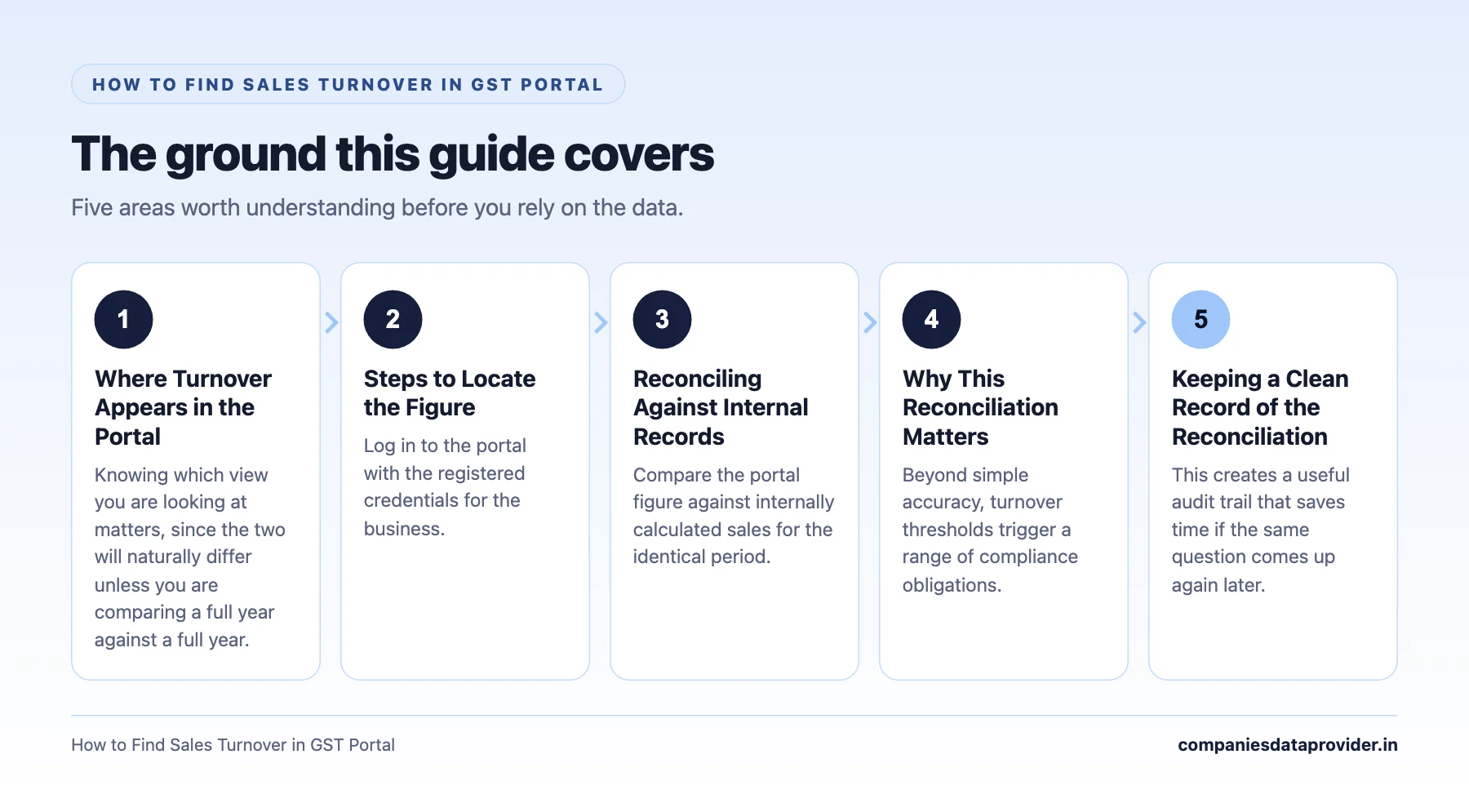
Turnover is typically summarised at both the return level, covering a single filing period, and at an aggregate level covering a full financial year. Knowing which view you are looking at matters, since the two will naturally differ unless you are comparing a full year against a full year.
Steps to Locate the Figure
- Log in to the portal with the registered credentials for the business.
- Navigate to the returns or summary dashboard.
- Select the desired period, whether a single return or the full year.
- Note the turnover figure displayed, along with the exact period it covers.
Reconciling Against Internal Records
Compare the portal figure against internally calculated sales for the identical period. A close match confirms the business’s own records and its filings are aligned; a gap points to either an unfiled transaction or a timing difference that needs investigation.
Common Sources of Mismatch
Frequent culprits include a sale recorded internally but not yet reported through a filing, a credit note applied in one system but not the other, and simple period boundary differences between the internal calendar and the filing cycle.
Why This Reconciliation Matters
Beyond simple accuracy, turnover thresholds trigger a range of compliance obligations. Reconciling the portal figure regularly, rather than only at year end, reduces the risk of an unexpected threshold breach going unnoticed until it causes a filing problem.
Keeping a Clean Record of the Reconciliation
Save a dated snapshot of the portal turnover figure each time you reconcile, along with a short note on any gap identified and how it was resolved. This creates a useful audit trail that saves time if the same question comes up again later.
Frequently Asked Questions
Is sales turnover figures difficult for a small business to gather?
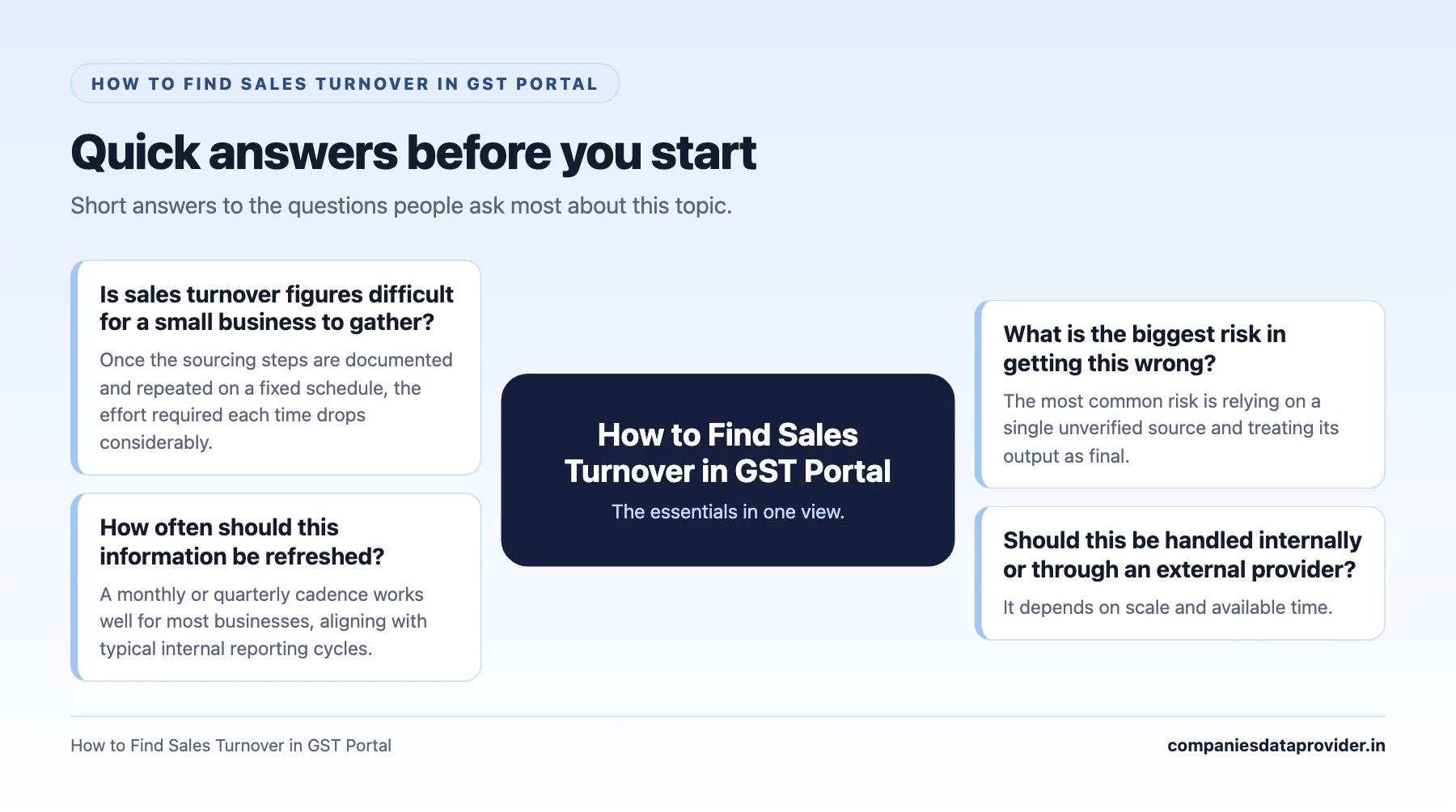
Not usually. The individual steps involved in gathering sales turnover figures are straightforward; what trips businesses up is treating the task as a one-off scramble rather than a routine habit. Once the sourcing steps are documented and repeated on a fixed schedule, the effort required each time drops considerably.
How often should this information be refreshed?
A monthly or quarterly cadence works well for most businesses, aligning with typical internal reporting cycles. Businesses operating in a fast-moving sector may prefer a tighter cycle, while smaller or more stable operations can often manage with a longer one.
What is the biggest risk in getting this wrong?
The most common risk is relying on a single unverified source and treating its output as final. Cross-checking against at least one independent figure, even a rough one, catches the majority of errors before they cause downstream problems in reporting or compliance.
Should this be handled internally or through an external provider?
It depends on scale and available time. Businesses with modest volume and a bit of internal capacity often manage this comfortably in-house, while those with high volume, multiple entities, or limited internal bandwidth tend to find a specialist provider a more efficient use of resources.
A Practical Checklist Before You Begin
Before starting any exercise involving sales turnover figures, it helps to work through a short checklist so nothing important is missed along the way.
- Confirm the exact period and entity scope you actually need.
- Identify every source you intend to pull from, rather than relying on just one.
- Decide in advance how you will handle duplicate or conflicting entries.
- Set aside time to validate totals before treating any figure as final.
- Agree on a consistent file naming and storage convention with anyone else involved.
- Note who will own this task going forward, so it does not fall through the cracks next period.
Working through this list takes only a few minutes but saves considerably more time later, particularly when the same exercise needs to be repeated in a future period.
How Businesses Use This Data Day to Day
Beyond any single reporting deadline, sales turnover figures tends to feed into a surprising number of everyday decisions once it is reliably available. Finance teams lean on it during budgeting and forecasting cycles, while operational teams use it to sanity-check assumptions about customers, suppliers, or market position.
The businesses that get the most value out of this kind of information are rarely the ones with the most sophisticated tools; they are the ones that treat gathering it as a routine habit rather than an occasional emergency, so the data is always current when a real question comes up.
Common Mistakes Worth Avoiding
A handful of mistakes show up repeatedly when businesses first start working with sales turnover figures, and most are easy to avoid once you know to look for them.
- Relying on a single source without any independent cross-check.
- Mixing figures from different periods without clearly labelling the boundary.
- Failing to record where a figure came from, making it hard to defend later.
- Treating an estimate as if it were a confirmed, precise number.
None of these mistakes require sophisticated tools to fix, only a bit of consistent discipline applied every time the task is repeated.
Keeping Records Audit-Ready
Whatever process you settle on for gathering sales turnover figures, keep the underlying records organised well enough that they could be handed to an auditor or reviewer without extra preparation. This means dated exports, a clear note of the source for each figure, and a record of any adjustment made along the way.
Businesses that treat this kind of record-keeping as an ongoing habit, rather than something assembled hurriedly when a review is announced, consistently find the review process itself far less stressful.
Weighing a Manual Process Against a Specialist Provider
For occasional or low-volume needs, gathering sales turnover figures manually through the available public and internal sources is usually perfectly workable. As volume grows, or as the need extends to tracking multiple companies or a longer historical window, a specialist data provider often becomes the more efficient choice, trading a subscription cost for a significant reduction in manual effort.
There is no universally correct answer here; the right choice depends on how central this data is to your ongoing decisions and how much internal time you can reasonably dedicate to maintaining it yourself.
Building This Into a Recurring Routine
The single biggest difference between businesses that find sales turnover figures genuinely useful and those that find it a constant source of stress is whether the task is treated as a recurring routine or a one-off emergency. A routine, however light, means the data is always close to current whenever it is actually needed.
Setting a fixed date each period, assigning clear ownership, and keeping a short written record of the steps involved turns what might otherwise be an ad hoc scramble into something a new team member could pick up and follow without much guidance.
Over time, this kind of routine also builds a useful historical archive, since each period’s extraction is saved alongside the ones before it, making trend analysis possible without any extra effort beyond what was already being done for compliance or reporting purposes.
Data Quality Signals Worth Watching
Even a well-sourced set of records related to sales turnover figures can degrade in quality over time if nobody is actively watching for warning signs. A handful of simple signals tend to catch most problems early, well before they show up as a larger discrepancy during a formal review.
- A sudden, unexplained jump or drop compared with the prior period.
- A counterparty name appearing under several slightly different spellings.
- A gap in the expected sequence of records for a given period.
- A total that no longer reconciles cleanly against an independent source.
Reviewing these signals as a short routine step, rather than only investigating when something obviously breaks, keeps the underlying data trustworthy for far longer with comparatively little ongoing effort.
Getting the Most Value From the Effort Involved
Gathering sales turnover figures takes real effort, so it is worth being deliberate about extracting as much value from that effort as possible rather than treating the output as useful for only a single purpose. The same underlying data that satisfies a compliance requirement can usually also inform a budgeting decision, a supplier conversation, or a simple management review, provided it is stored in a way that makes it easy to revisit.
A little extra care at the point of extraction, such as adding a category tag or a brief note on anything unusual, pays for itself many times over the first time that same data is needed again for an entirely different purpose.
Final Thoughts
The turnover figure inside the filing portal is a genuinely useful independent check on a business’s own records, provided it is located, compared, and reconciled with the same discipline applied to any other important financial figure.
98 Lists Across 7 Groups
Every group below is a live category page with its own lists, pricing and free sample. Pick the one closest to your market and drill in.
Talk To Us About A Custom Pull