Data Privacy Notice: Buying or selling an individual’s personal information is illegal — we respect data privacy and never provide, offer or sell personal (individual) data to anyone. Reselling data purchased from us is a punishable offence under Indian Copyright Law.
B2B Companies Data
GST & Registration Data
Industry & Trade Data
City & State Wise Data
Professional & Service Data
International Buyers & Sellers
Exhibitors & Combo Packs
gst sales data service is best understood as a sales database topic, not as a plain directory of names. The useful question is how sales records are sourced, structured, refreshed, filtered, exported, governed, and reviewed before anyone uses them for outreach or market analysis.
Aggregate Totals and How They Are Built
A total figure is only as trustworthy as the records it is built from, and a provider that cannot explain which records were included, and for which period, is asking you to trust an aggregate you cannot independently reconstruct.
Ask whether an aggregate total can be broken back down into the individual records that produced it, since a total that cannot be decomposed is much harder to sanity-check against anything else you already know.
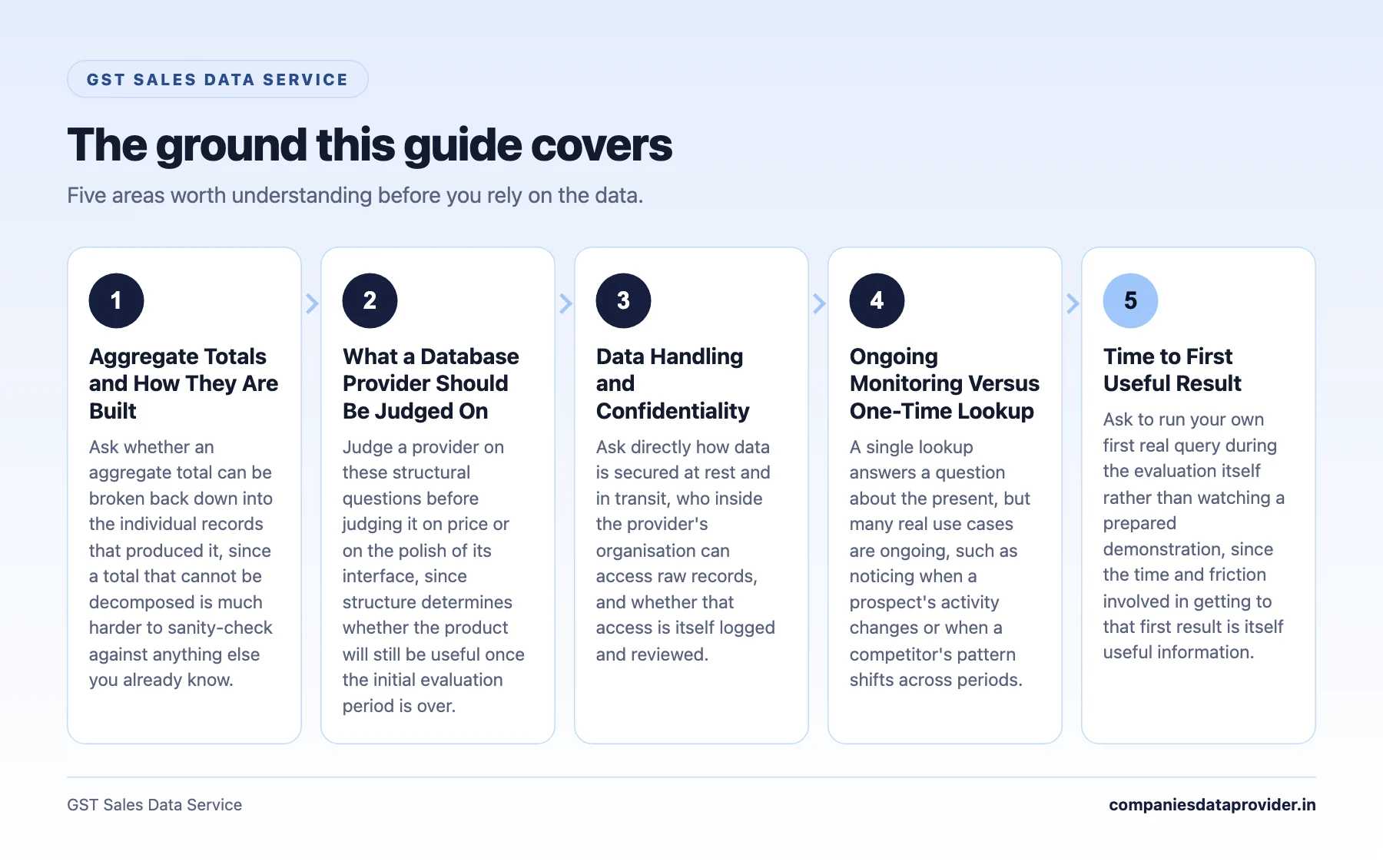
What a Database Provider Should Be Judged On
Providers in this space tend to differ less on whether they have data at all and more on structure: whether registrations are linked to entities, whether search tolerates real-world name variation, and whether export preserves what the interface shows.
Judge a provider on these structural questions before judging it on price or on the polish of its interface, since structure determines whether the product will still be useful once the initial evaluation period is over.
Data Handling and Confidentiality
Because the underlying records concern other businesses’ filings, how a provider stores, secures, and restricts that data matters beyond ordinary vendor due diligence, particularly if your own contracts include confidentiality commitments to your clients.
Ask directly how data is secured at rest and in transit, who inside the provider’s organisation can access raw records, and whether that access is itself logged and reviewed.
Ongoing Monitoring Versus One-Time Lookup
A single lookup answers a question about the present, but many real use cases are ongoing, such as noticing when a prospect’s activity changes or when a competitor’s pattern shifts across periods.
Ask whether the product supports saved searches or recurring alerts on a defined set of businesses, or whether staying current requires manually repeating the same query on a schedule and comparing results by hand.
Time to First Useful Result
Some hosted systems are usable within minutes of access being granted, while others require a setup period before a first meaningful query can be run, and that gap is easy to underestimate during a sales conversation.
Ask to run your own first real query during the evaluation itself rather than watching a prepared demonstration, since the time and friction involved in getting to that first result is itself useful information.
Registration Versus Entity Records
A business operating from more than one place typically holds a separate registration in each state, and a data source that treats every registration as an unrelated record will misstate anything that depends on counting or grouping by business rather than by filing.
Before relying on a source, check whether it links registrations belonging to the same business under one entity view, or whether that linking has to be reconstructed by hand from names and addresses that may not match exactly.
Export Volume and Format
Most evaluation happens on-screen, but real use tends to move into a spreadsheet or an internal system, and that is where volume limits, row caps, and per-period export ceilings quietly become the real constraint on the product.
Ask directly what the export ceiling is, whether it resets daily or monthly, and whether the exported file preserves the same identifiers and fields shown on-screen, since a trimmed export undoes half the value of what looked complete in the interface.
Search Reliability Under Name Variation
Business names in filings are rarely written the same way twice: short forms, transliterated spellings, and legal-suffix differences are common, and a search box that only matches an exact or near-exact string will quietly under-report coverage.
Test this with names you already know are present, typing them the way a colleague unfamiliar with the exact registered form would type them, and treat a search that fails on reasonable variants as a real defect, not a minor inconvenience.
Coverage Disclosure by Region and Category
No provider holds uniform depth everywhere; coverage tends to vary by state, by sector, and by how recently a filing was made, and a provider unwilling to describe that variation is asking buyers to treat every result as equally reliable.
A provider who can describe where their holdings are thinner and where they are strongest is one who actually measures their own data; a provider who only offers reassurance in general terms usually cannot answer the question at all.
Latency Between Filing and Availability
The gap between a transaction being filed and it becoming visible in a hosted database is rarely a single number; it varies by state, by filer size, and by how the provider ingests updates.
Ask for the lag that applies to the regions and categories relevant to your own use, not a headline average, since an average across the whole country can look far better than what you would actually experience.
Historical Depth and Trend Comparison
A single snapshot rarely answers a business question on its own; most real analysis compares one period against another to see which relationships are growing, which have gone quiet, and which are new.
Confirm how many past periods are retained, whether older periods can still be queried at full detail rather than only as a rolled-up summary, and whether comparing two periods is a built-in function or something to be reconstructed manually.
Running a Structured Evaluation
A short demonstration is designed to show a product’s strengths and rarely surfaces its limits, so a fair evaluation needs the same handful of test questions run against every provider under consideration.
Keep a written record of what each provider actually returned for each test rather than a general impression afterward, because providers in this space tend to be strong in different places rather than uniformly better or worse than one another.
Involving the People Who Will Actually Use It
Whoever negotiates the contract is rarely whoever will run daily queries, and each will notice different problems: one focuses on terms and pricing structure, the other on whether the search and export actually work as claimed.
Have both groups test the product separately and record their findings independently before comparing notes, since a disagreement between them usually points at a genuine trade-off worth discussing rather than a matter of taste.
Exit and Data-Portability Provisions
Any analysis built inside a hosted interface encodes assumptions about how that interface structures data, and moving to a different provider later means rebuilding those assumptions from scratch unless the exit terms are settled early.
Secure, before signing, a clear right to a full extract on termination, in a format that preserves the same identifiers used throughout the relationship, along with clarity on what happens to any saved views or groupings you built along the way.
Access Control Across Teams
Data on other businesses’ filings is commercially sensitive, and a provider that only supports one shared login for an entire organisation makes it hard to see who queried what or to remove access when someone changes roles.
Ask whether individual accounts, scoped permissions, and an activity log are available, since a shared login is a governance gap that tends to go unnoticed until it becomes a problem during an audit or a personnel change.
Duplicate and Near-Duplicate Records
The same underlying filing can sometimes surface more than once under slightly different formatting, and an interface that does not deduplicate will quietly inflate counts and skew any ranking built on top of them.
Pick a handful of records you can check independently and look for duplicates before trusting an aggregate figure produced by the system, particularly any count or ranking that will be presented to someone outside the team that built it.
Comparing Providers on Equal Terms
It is tempting to compare providers on price alone, but price differences usually trace back to differences in coverage depth, export limits, or how much manual reconciliation the buyer will end up doing afterward.
Build a short table of the same criteria applied to every provider under consideration, and only then bring price into the comparison, so that a lower headline price is not mistaken for a lower total cost of use.
FAQ
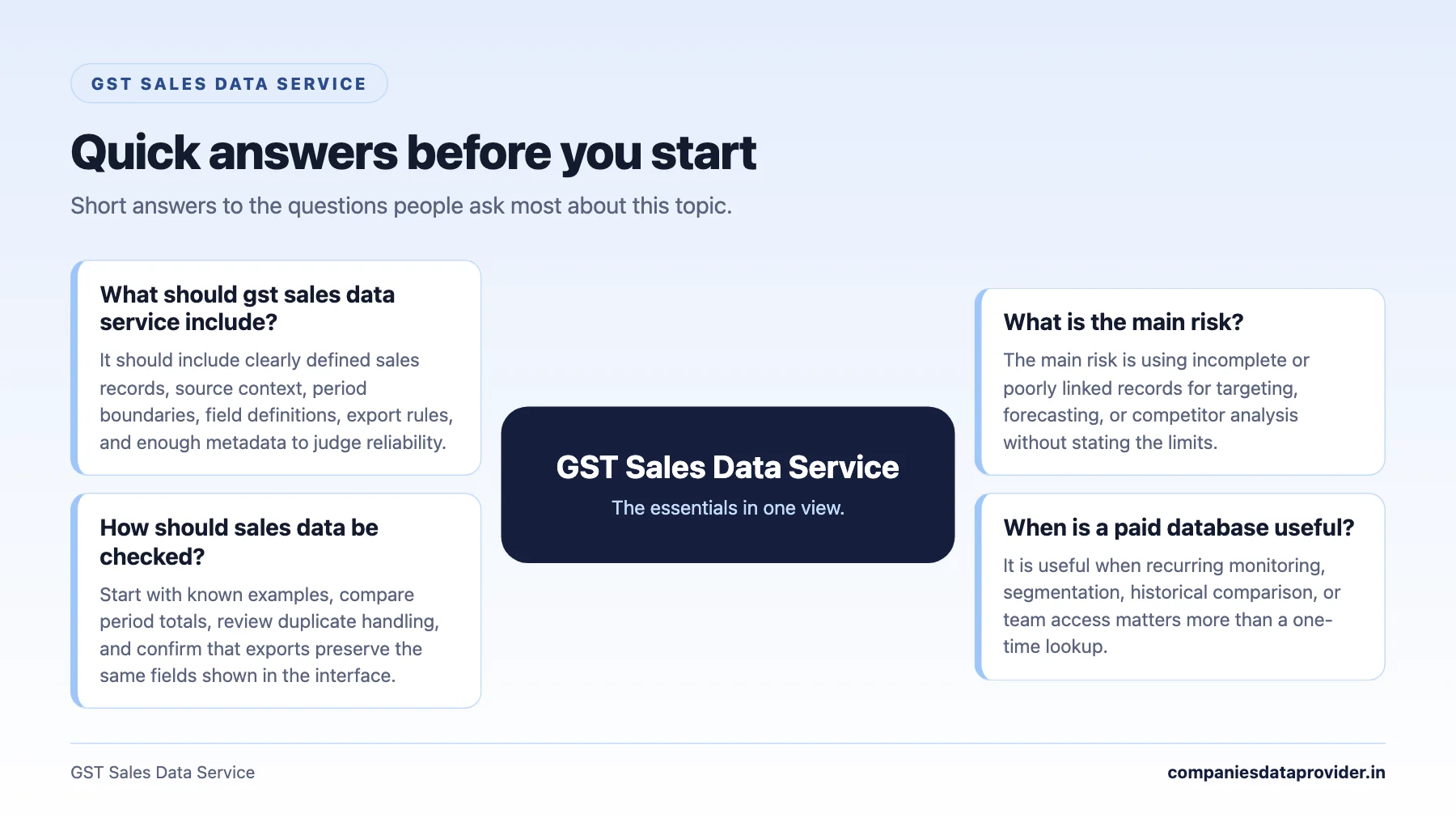
What should gst sales data service include?
It should include clearly defined sales records, source context, period boundaries, field definitions, export rules, and enough metadata to judge reliability.
How should sales data be checked?
Start with known examples, compare period totals, review duplicate handling, and confirm that exports preserve the same fields shown in the interface.
What is the main risk?
The main risk is using incomplete or poorly linked records for targeting, forecasting, or competitor analysis without stating the limits.
When is a paid database useful?
It is useful when recurring monitoring, segmentation, historical comparison, or team access matters more than a one-time lookup.
Closing Thought
gst sales data service becomes useful when it is treated as governed sales intelligence: sourced carefully, tested with known cases, documented clearly, and exported in a form teams can actually use.
98 Lists Across 7 Groups
Every group below is a live category page with its own lists, pricing and free sample. Pick the one closest to your market and drill in.
Talk To Us About A Custom Pull