Data Privacy Notice: Buying or selling an individual’s personal information is illegal — we respect data privacy and never provide, offer or sell personal (individual) data to anyone. Reselling data purchased from us is a punishable offence under Indian Copyright Law.
B2B Companies Data
GST & Registration Data
Industry & Trade Data
City & State Wise Data
Professional & Service Data
International Buyers & Sellers
Exhibitors & Combo Packs
How Do I Check My GST Purchase Details
Published 2026-09-29
Owners who ask how to check my GST purchase details are usually preparing a return or investigating a mismatch. The steps are straightforward once you know which statement reflects supplier filings and which reflects your own entries.
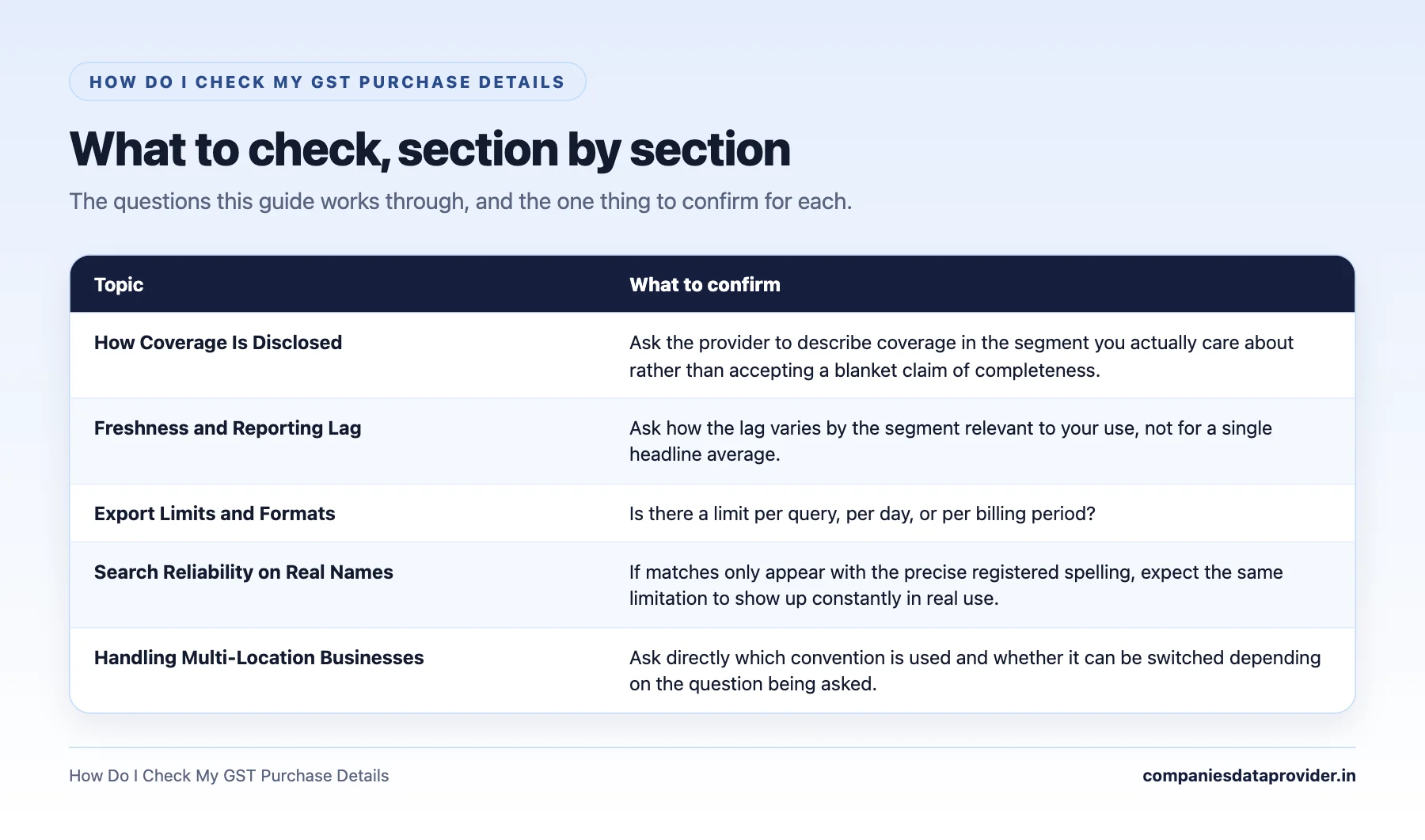
How Coverage Is Disclosed
Coverage in reviewing my own GST purchase details is never uniform across regions, sectors, or business sizes, which means the reliability of any single result depends on what sits behind it.
Ask the provider to describe coverage in the segment you actually care about rather than accepting a blanket claim of completeness. A specific, qualified answer usually signals a team that measures its own holdings; a vague reassurance usually signals the opposite.
Freshness and Reporting Lag
There is always a gap between an underlying filing event and the moment reviewing my own GST purchase details reflects it, and that gap is rarely the same across every category or region a vendor serves.
Ask how the lag varies by the segment relevant to your use, not for a single headline average. A quoted average can hide a much longer delay in exactly the area you plan to rely on for time-sensitive decisions.
Export Limits and Formats
Almost every provider of reviewing my own GST purchase details caps how much can be pulled out of the interface in one sitting, and the cap is rarely advertised until a real workflow bumps into it.
- Is there a limit per query, per day, or per billing period?
- Which file formats are supported for a bulk pull?
- Are the same fields available in export as in the on-screen view?
- Can a large pull be scheduled rather than run manually each time?
Confirm these details before committing rather than after a workflow depends on them, since renegotiating a limit after signing is a weaker position than asking about it during evaluation.
Search Reliability on Real Names
Business names in practice carry abbreviations, spelling variants, and inconsistent punctuation, and a search tool for reviewing my own GST purchase details that depends on an exact registered form will quietly fail on a meaningful share of genuine matches.
Test this directly with names you already know are present, typed the way you would naturally type them rather than copied verbatim from an official filing. If matches only appear with the precise registered spelling, expect the same limitation to show up constantly in real use.
Handling Multi-Location Businesses
A single business with branches in several states will typically hold several registrations, and reviewing my own GST purchase details needs a defensible way to decide whether those branches are treated as one entity or many for reporting purposes.
Ask directly which convention is used and whether it can be switched depending on the question being asked. A fixed convention will be right for some analyses and quietly wrong for others, and there is no way to tell which from the output alone.
How Far Back History Goes
Trend and pattern questions depend on how many past periods reviewing my own GST purchase details actually retains, and retention windows vary a great deal between providers even when their live data looks similar on the surface.
Ask specifically how many past periods are retained and whether older records are archived at reduced detail rather than dropped outright. A shallow history is fine for a snapshot but will not support any question phrased as “how has this changed.”
How Records Get Verified
Not every provider of reviewing my own GST purchase details verifies records the same way, and the verification method affects how much weight a single result can bear in a decision.
Ask what checks are run before a record is made available, and whether corrections are tracked when a business disputes an entry. A provider with no visible correction process is one where errors, once introduced, tend to persist indefinitely.
Using It for Benchmarking
Benchmarking against peers is one of the more common reasons teams look at reviewing my own GST purchase details, and it depends on being able to compare like with like across a defined peer set rather than a single figure in isolation.
Confirm that the interface can hold a saved peer group and rerun the same comparison across periods, rather than requiring the group to be rebuilt by hand each time a fresh comparison is needed.
Support During Evaluation
How a vendor answers a genuinely difficult question about reviewing my own GST purchase details during evaluation is a reasonable preview of how they will behave once you are a paying customer and something goes wrong.
Bring a specific, slightly awkward question rather than a generic one, and note whether the answer is precise or deflects into marketing language. The difference tends to be a durable signal, not a one-off.
Programmatic Access
Where reviewing my own GST purchase details needs to feed an internal system rather than be viewed manually, ask whether programmatic access exists, what it costs beyond the base plan, and whether it exposes the same fields as the interface.
A provider that treats programmatic access as an afterthought will often lag the main product in coverage and reliability, which matters if a downstream process is going to depend on it running unattended.
Understanding the Pricing Structure
Pricing for reviewing my own GST purchase details is rarely a single flat figure once seats, export volume, refresh frequency, and programmatic access are all accounted for separately.
Ask for a full breakdown against the way your team will actually use the product, rather than a headline price that assumes light use. The gap between the two is where budgets are most often surprised later.
What a Trial Should Actually Test
A short trial period is only useful if it is spent testing the specific weaknesses that matter for your use of reviewing my own GST purchase details, rather than browsing the interface casually.
Bring a fixed list of real businesses and real questions into the trial, run them against every vendor under consideration, and record the outcome for each rather than forming a general impression at the end.
Planning for an Eventual Exit
Work built on top of reviewing my own GST purchase details inside a vendor’s interface tends to encode assumptions specific to that vendor, and moving to another provider later means rebuilding rather than transferring.
Secure the right to a full extract on termination, covering the same fields and structure used during the relationship, before signing rather than after a decision to leave has already been made.
Data Handling and Access Control
Because reviewing my own GST purchase details touches information about other businesses, it is reasonable to ask how access is controlled internally, who can see what, and how long records are retained after an account is closed.
A provider without a clear answer on internal access control is one where sensitive business information may be more widely visible inside their own organisation than a buyer would assume.
Filtering to a Useful Scope
Raw access to reviewing my own GST purchase details is rarely useful on its own; the value comes from being able to filter down to a scope narrow enough to act on, whether that is a region, a sector, or a size band.
Test whether filters can be combined and saved for reuse, since rebuilding the same filtered view by hand every time it is needed adds friction that eventually discourages people from using the tool at all.
Performance Under Realistic Load
Demonstration queries during a sales pitch are chosen because they run quickly; the queries that matter are the ones you will actually run once the product is in daily use for reviewing my own GST purchase details.
Test broad, multi-period queries specifically, since these are both the most common in practice and the slowest in most systems. A tool that is too slow for exploration will only ever be used for scheduled reports.
Running a Structured Evaluation
- Test every vendor under consideration against the same fixed list of businesses and questions.
- Record results per capability rather than as one overall impression.
- Note where a vendor is strong and where the same vendor is weak, since few are strong everywhere.
- Repeat the same tests after any trial period ends, not only during it.
A shared test set removes the advantage a vendor gets from steering a demonstration toward its own strengths, and it produces a comparison that survives being explained to someone who was not in the room.
Involving the People Who Will Use It
An evaluation of reviewing my own GST purchase details run entirely by whoever manages the vendor relationship tends to reach different conclusions than one run by whoever will query the product daily.
Have the people who will actually use the tool run the capability tests, while whoever owns the commercial relationship handles terms and pricing separately. Record both assessments rather than averaging them into one score.
FAQ
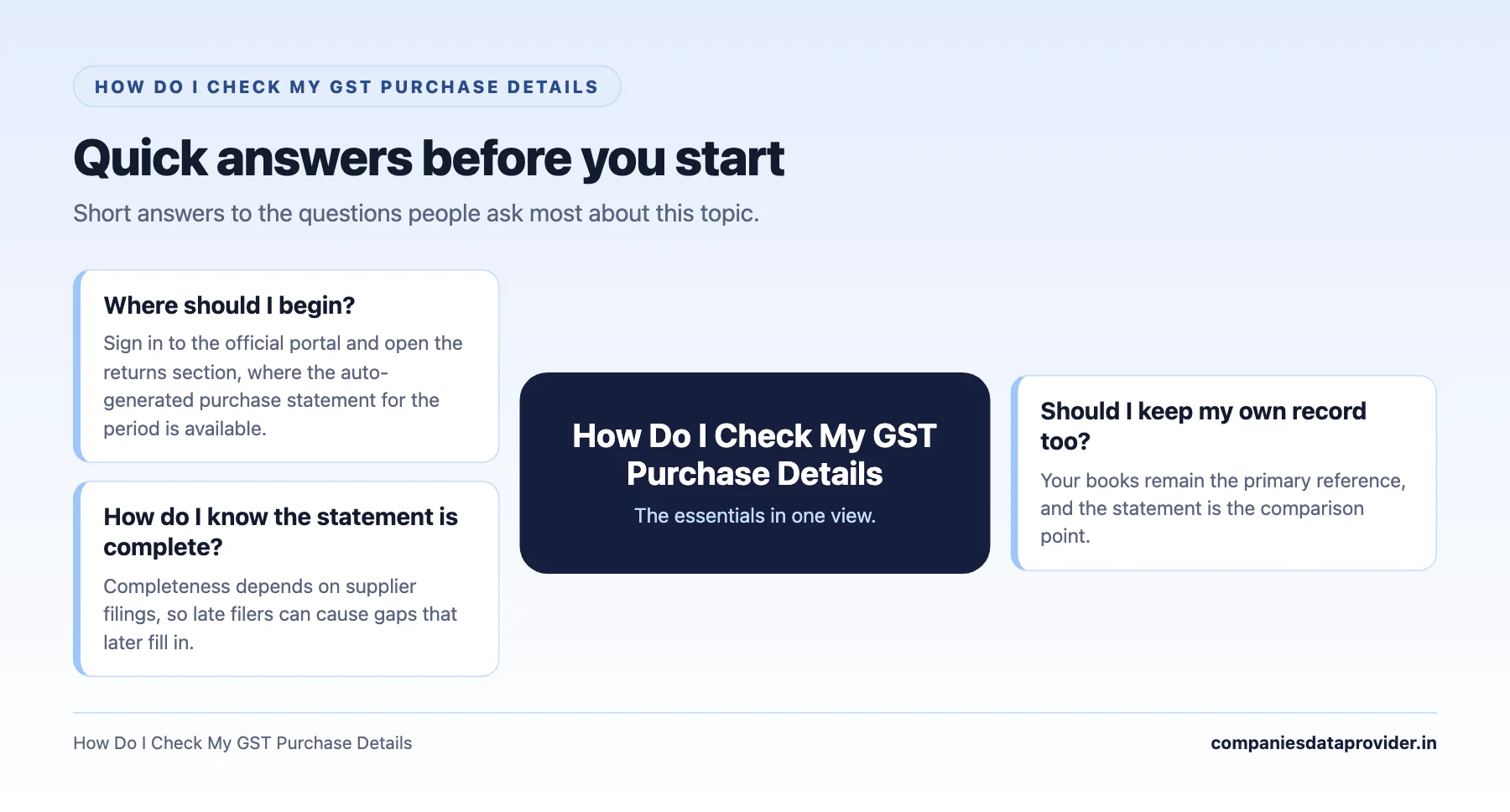
Where should I begin?
Sign in to the official portal and open the returns section, where the auto-generated purchase statement for the period is available.
How do I know the statement is complete?
Completeness depends on supplier filings, so late filers can cause gaps that later fill in.
Should I keep my own record too?
Yes. Your books remain the primary reference, and the statement is the comparison point.
Closing Thought
Whatever the route, reviewing my own GST purchase details is worth approaching with a short checklist, a small real-world sample and a clear record of what was verified. That habit protects the decision far better than any single figure or claim.
98 Lists Across 7 Groups
Every group below is a live category page with its own lists, pricing and free sample. Pick the one closest to your market and drill in.
Talk To Us About A Custom Pull