Data Privacy Notice: Buying or selling an individual’s personal information is illegal — we respect data privacy and never provide, offer or sell personal (individual) data to anyone. Reselling data purchased from us is a punishable offence under Indian Copyright Law.
B2B Companies Data
GST & Registration Data
Industry & Trade Data
City & State Wise Data
Professional & Service Data
International Buyers & Sellers
Exhibitors & Combo Packs
HSN Sales Purchase Database of Any Company
Published 2026-09-15
A database that promises classification-level sales and purchase records for any company is making two claims at once: that classification detail is genuinely queryable, and that coverage really does extend to whichever company you pick, not only the well-known ones a demonstration would naturally reach for.
Category and Classification-Level Granularity
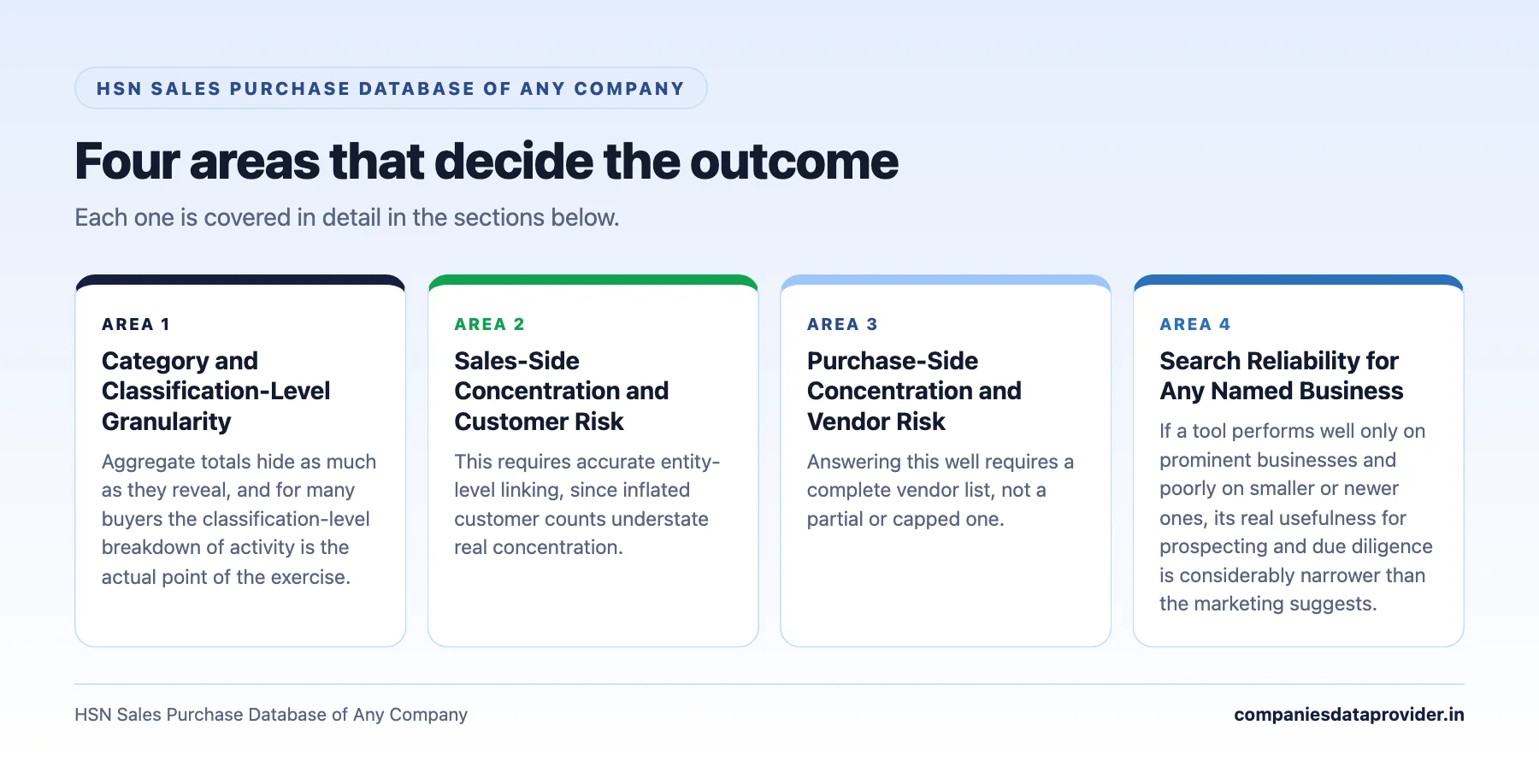
Aggregate totals hide as much as they reveal, and for many buyers the classification-level breakdown of activity is the actual point of the exercise. Whether a database exposes this breakdown as a queryable field, rather than burying it inside a downloadable document, determines how usable the data really is.
Test whether you can filter and group by classification code directly inside the interface. Where this is only available through a raw export, the practical cost of every classification-level question rises sharply, and the tool ends up used far less than its coverage would suggest.
Sales-Side Concentration and Customer Risk
On the sales side, the equivalent question is customer concentration: how dependent revenue is on a small number of buyers, and how that dependency is trending over time. This requires accurate entity-level linking, since inflated customer counts understate real concentration.
Ask whether concentration can be tracked as a trend across periods, not just as a single current snapshot, since a worsening trend is often more actionable than a static figure.
Purchase-Side Concentration and Vendor Risk
On the purchase side, the central risk question is usually concentration: how much of total spend flows through a small number of vendors, and what would happen if one of them became unreliable. Answering this well requires a complete vendor list, not a partial or capped one.
Ask whether the interface can rank vendors by share of total activity directly, rather than requiring an export and a manual calculation every time the question comes up.
Search Reliability for Any Named Business
A claim that any business can be looked up is only as strong as the search behind it, and the honest test is trying it with businesses you already know are obscure, small, or recently registered rather than well-known ones that any dataset would find easily.
If a tool performs well only on prominent businesses and poorly on smaller or newer ones, its real usefulness for prospecting and due diligence is considerably narrower than the marketing suggests.
Entity Versus Registration Linking
Many businesses hold more than one registration, and whether a database understands that several registrations belong to the same underlying business changes almost every analytical conclusion drawn from it. A structure that treats each registration as a separate customer will overstate customer counts and understate concentration.
Test this directly with a business you know operates under more than one registration. If the interface shows it as several unconnected records with no way to view them together, treat every aggregate figure in the system with real caution.
Deduplication and Record Quality
Duplicate or near-duplicate records are common wherever registrations are captured from multiple filing events, and they quietly inflate counts in ways that are hard to notice until a specific number looks implausibly high.
Ask what deduplication logic is applied and whether you can inspect near-duplicate candidates rather than having them silently merged or silently left apart. Either extreme, blind merging or no merging at all, creates a different but equally real distortion in aggregate figures.
Data Governance and Usage Rights
Understand exactly what you are permitted to do with the data once you have it: whether it can be shared internally across teams, incorporated into your own products, or retained after a contract ends. These rights vary considerably between providers and are easy to overlook amid feature comparisons.
Ask for the usage terms in plain language rather than relying on a summary, and have them reviewed before signing if the intended use is anything beyond straightforward internal reporting.
Coverage Breadth Across Sectors
Coverage is rarely uniform across sectors, and a database that performs well in one line of business can be thin in another. A single overall coverage claim from a provider tells you almost nothing about how it will perform for the sector you actually care about.
Ask for coverage broken down by the sector and category relevant to your evaluation, not an aggregate figure. Providers who can answer specifically are describing holdings they actually measure; a vague reassurance in place of a specific answer is itself a useful signal about how the data is maintained.

Search Reliability and Name Variation
Searching for a business by name is the first thing most people try, and it is also where hosted databases most often disappoint. Registered names carry transliteration differences, abbreviations, and legal-suffix variants that a naive exact-match search will simply miss.
- Does search tolerate partial names and common abbreviations?
- Are legal-form suffixes handled automatically?
- Does a misspelled or partial query return ranked suggestions rather than nothing?
Search a handful of businesses you already know are covered, typing the names the way you naturally would. A tool that only finds them with the exact registered spelling will feel like it has poor coverage even when the underlying records are present.
Latency Between Filing and Availability
There is always a gap between when activity happens and when it becomes visible in a hosted database, and providers tend to quote this gap as a single reassuring figure. In practice the delay varies by sector, region, and even by the size of the filer.
Ask how the delay is measured and whether it is reported as a typical case or a worst case. For any use built around timely outreach, the delay that matters is the one applying to the segment you are watching, not the average across the whole dataset.
Multi-State and Territory Handling
Businesses operating across several states are registered separately in each, and a database that only understands state-level registration cannot answer questions that are naturally asked at the level of the business as a whole. Territory management, in particular, rarely maps cleanly onto state boundaries.
Ask whether the interface can group registrations into custom territories and whether historical queries can be re-run under an earlier grouping. Territory definitions change more often than the underlying data, and reproducing a past analysis depends on knowing which definition applied at the time.
Export Volume and Format Limits
- Is there a cap on rows per export, per day, or per period?
- Which identifiers are preserved on export, and which are dropped?
- Can historical periods be exported for side-by-side comparison?
- Is the exported file structured for direct use, or does it need cleanup first?
Export limits are easy to overlook during a demonstration because demonstrations rarely export at real scale. Ask explicitly about caps before committing, and test an export at the volume you expect to need rather than trusting a stated limit that may not reflect real-world throttling.
Historical Depth and Trend Analysis
Trend analysis requires history, and providers vary widely in how far back their usable records extend. A database with strong current coverage but shallow history will support prospecting well and trend analysis poorly.
Ask specifically how many prior periods are queryable, not merely stored, since some systems retain older records but do not expose them through the same query tools available for recent data. A trend view built from inconsistent depth across periods will mislead more than it informs.
Data Freshness and Update Frequency
Freshness and coverage are different properties, and a database can be broad while being updated too infrequently to be useful for time-sensitive work. Ask how often records are refreshed and whether that cadence is uniform across sectors and regions.
Where the refresh cycle is uneven, the practical effect is that some parts of the dataset always look more current than others regardless of what has actually changed. Understanding which parts of your evaluation depend on freshness will tell you how much this variation actually matters to you.
FAQ
What is the single most important capability to test first?
Whether registrations belonging to the same business are linked together, since customer counts, vendor counts, and concentration figures all depend on that linkage being correct.
Why does name-based search deserve dedicated testing?
Because name variation is structural in this market, and a search that only matches exact registered spelling will feel like poor coverage even when the underlying records are actually present.
How should export limits be evaluated?
By testing an export at the volume you actually expect to need, since demonstration exports rarely reveal caps that only appear at real scale.
Is a single coverage percentage a useful number on its own?
Not on its own. Coverage varies by sector and region, so ask for a breakdown relevant to your own use case rather than accepting an aggregate figure.
Closing Thought
Treat both halves of this claim as separate things to verify: test classification-level filtering directly inside the interface, and test coverage against a deliberately obscure company before trusting the tool for the company that actually matters to you.
98 Lists Across 7 Groups
Every group below is a live category page with its own lists, pricing and free sample. Pick the one closest to your market and drill in.
Talk To Us About A Custom Pull